
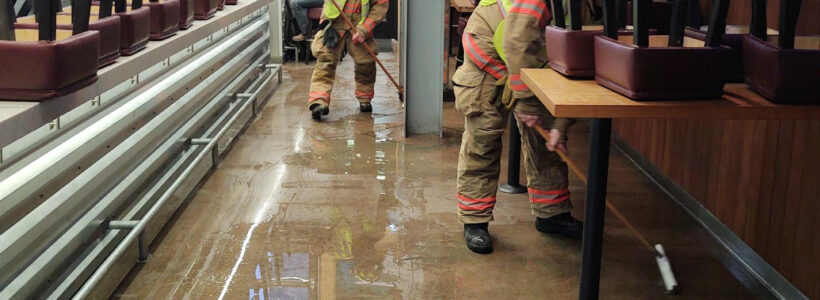
Commercial Fire Sprinkler Water Damage in Minnesota
A sprinkler head lets go at 2 a.m. in a vacant suite. By the time the alarm company calls, water has run through the ceiling grid, into the walls, and down to the floor below.
Fire sprinkler water damage moves fast because a sprinkler keeps flowing until someone shuts it off. Kiser Construction handles the cleanup and the rebuild for commercial properties across Minnesota. Our emergency line, (612) 518-8852, is answered 24/7 by a real person.
Is this the right page?
- You own a home, not a commercial building, and a pipe broke. See burst pipe cleanup.
- You want the full range of our commercial work. Visit commercial restoration services.
- You want the drying process explained step by step. Start with water damage restoration.
Who Fixes What After a Sprinkler Discharge
Two different contractors are involved. It helps to know who does what.
In Minnesota, only people who meet state license and certification rules can work on fire sprinkler systems. That rule comes from Minnesota Statutes, Chapter 299M. So your licensed fire protection contractor fixes the pipe, swaps the head, and puts the system back in service.
Kiser Construction handles everything the water touched. We extract the water, dry the building, document the damage, and rebuild the ceilings, walls, and floors. We don’t work on the sprinkler system itself.
Call both. Your fire protection contractor can also tell you how to handle the building while the system is out of service.
Why Sprinkler Lines Break in Minnesota Winters
Most winter sprinkler losses have one cause. Cold air reaches a pipe that holds water. The National Fire Sprinkler Association says sprinklered areas need to stay at 40 degrees or warmer. Spaces that can’t stay that warm usually get a dry pipe or antifreeze system instead.
The trouble spots are the ones nobody thinks about in July.
- Entry vestibules and stairwells
- Vacant or unoccupied spaces
- Areas near skylights
- Spaces that were never well insulated
Dry pipe systems aren’t immune. Condensation collects at low points in the piping and has to be drained before cold weather and after the system operates. If it isn’t, that water can damage the system and the building.
An accidental trip is another cause. When a dry pipe valve trips, water fills the pipes. In a cold space, that turns a dry system into a wet one that can freeze.
Antifreeze systems need attention too. NFSA notes they should be tested before freezing weather to make sure the solution still protects to local temperatures.
Why Sprinkler Heads Go Off Without a Fire
Freezing is the big one here, but it isn’t the only one. Heads get knocked by ladders during remodel and repair work. Tenants hit them by accident. A head can also fail on its own.
That’s why the cause matters after the water is out. Owners, tenants, and insurers may all want to know what happened. Keep the failed head or fitting instead of tossing it. An engineer may need to look at it.
What We Do on a Sprinkler Water Damage Loss
- Walk the building with you. We trace where the water went, including floors below and suites next door.
- Extract standing water from floors, carpet, and ceiling cavities.
- Remove wet ceiling tiles, drywall, insulation, and flooring that can’t be dried in place.
- Set drying equipment and read moisture levels daily until materials reach the dry standard.
- Document everything. Our DocuSketch camera captures 360-degree images of each area and builds measured floor plans.
- Rebuild. Ceilings, walls, flooring, and trim go back in. One company handles mitigation and reconstruction.
We’re a licensed general contractor, not a mitigation-only crew. The same company that dries the building puts it back together, so there’s no gap between the two.
Why Sprinkler Water Travels So Far
Sprinkler water doesn’t stay where it lands. It runs across the top of the ceiling grid and soaks the tiles. It follows pipes, wires, and gaps in the floor down to the next level. It wicks up into drywall. It sits in the insulation above the ceiling.
So the stain you see is rarely the whole story. A wet ceiling on the third floor can mean wet walls on the second floor and standing water on the first. We check moisture well past the stain before we decide what comes out.
Inventory, Files, and Contents
A sprinkler loss often hits more than the building. Stock, files, furniture, and equipment can all get wet.
We work with trusted contents cleaning partners who inventory, clean, and store what can be saved. Our water damage contents cleaning page explains how that works. Items get logged before they leave, so you have a record for your insurer and your tenants.
Ceilings Take the Worst of It
On most sprinkler losses, the ceiling below the head is the first thing to fail. Tiles sag, drywall softens, and insulation above the ceiling holds water against the framing. Our ceiling and drywall water damage repair page explains how we decide what can stay and what comes out.
You get a written scope before demolition. Our customer portal shows the job schedule in real time, so property managers can check status without waiting on a callback. For how we phase work and schedule around your hours, see our commercial restoration services page.
Steps for Property Managers in the First Hour
- Call your licensed fire protection contractor right away. They can stop the flow and restore protection.
- Call our 24/7 line at (612) 518-8852 to start water extraction.
- Keep people away from wet electrical equipment and sagging ceilings.
- Take photos and video of the damage before anything is moved.
- Move inventory, files, and electronics out of wet areas if it’s safe to do so.
- Warn tenants on the floors below. Water travels down.
- Set the failed head or fitting aside. Don’t throw it away.
Don’t wait for the sprinkler repair to start drying. The two jobs can run side by side. The longer water sits, the more has to come out, and the bigger the rebuild gets.
Why Property Managers Call Kiser Construction
- Restoring water and fire damage since 2008, in business since 2003.
- Commercial jobs from a single suite to a full building.
- Members of the Elk River, Anoka Area, I-94, Metro North, and Wayzata West Metro chambers of commerce.
Common Questions
No. In Minnesota, sprinkler system work is limited to licensed and certified people under Chapter 299M. Your fire protection contractor repairs the system. We handle the fire sprinkler water damage and the rebuild.
Yes. Our emergency line, (612) 518-8852, is answered 24/7 by a real person, including nights and weekends.
Yes. We take on commercial projects of any size, and we trace water through every floor and suite it reached.
Because the cause can matter later. Owners, tenants, and insurers may need to know why it went off, and an engineer may need to examine it. Hand it to your fire protection contractor or adjuster.
Photos, daily moisture readings, and 360-degree DocuSketch scans with measured floor plans. You get the written scope and the moisture logs.
Often part of it can. We phase commercial jobs so you keep part of the space open while we work in the rest. Loud work moves to evenings and weekends where the building allows.
Commercial properties across the Twin Cities metro and the northern suburbs, within a one to two hour drive of our Elk River office.
Call Us
Kiser Construction has been in business in Elk River since 2003. IICRC certified and licensed in Minnesota under BC416441. Every job carries a one-year warranty from completion.
Emergency line, any hour: (612) 518-8852. Office: (763) 633-2010.