

Ice Dam Removal and Interior Leak Repair in Minnesota
It’s February. Water is dripping from the top of a window frame, and a brown ring is spreading across the ceiling. Outside, a thick ridge of ice runs along the edge of the roof.
That ridge is an ice dam. Getting it off the roof is step one. Drying and fixing what the water already reached inside is step two. Most companies that sell ice dam removal only do step one. They clear the roof and leave. The wet insulation and the soaked ceiling are still your problem.
Kiser Construction does both parts. We steam the ice off the roof, then dry and repair the attic, ceilings and walls. We’re a licensed Minnesota contractor (BC416441) based in Elk River, and we’ve been doing this work since 2003.
What an ice dam is and why it keeps coming back
An ice dam forms when the upper part of your roof is warm enough to melt snow, but the edge is still below freezing. Melt runs down, hits the cold edge and freezes. The ridge grows. Water pools behind it and works its way under the shingles, into the roof deck and down into the house.
Where the heat comes from
The heat comes from inside the house. The University of Minnesota Extension explains that warm air leaking into the attic is the main cause in many homes. It’s often a bigger factor than thin insulation. Recessed lights, skylights, complex rooflines and heating ducts in the attic all raise the risk.
Why removing the ice is only half the fix
That’s why the same house gets ice dams every winter. Removing the ice stops this year’s leak. It doesn’t stop next year’s. The lasting fix is keeping heat out of the attic so the whole roof stays cold.
Signs you have an ice dam or ice dam damage
Some signs are on the roof. Others show up inside days or weeks later. Here’s what to watch for.
Thick ice and long icicles at the eaves
A ridge of ice along the roof edge, with icicles hanging from the gutters, is the classic sign. Big icicles mean water is running off the roof and refreezing.
Water at the top of windows and walls
Drips from the top of a window frame or wet spots high on an outside wall usually mean water got under the shingles and ran down inside the wall.
Ceiling stains and sagging drywall
Brown rings, peeling paint or a soft spot in the ceiling means water is sitting above it. Put a bucket under it and call. A sagging ceiling is a stay-out-of-the-room problem.
Wet or matted attic insulation
If you can safely look in the attic, frost on nails, damp wood or flattened insulation near the eaves are signs of both heat loss and water getting in.
How we remove ice dams
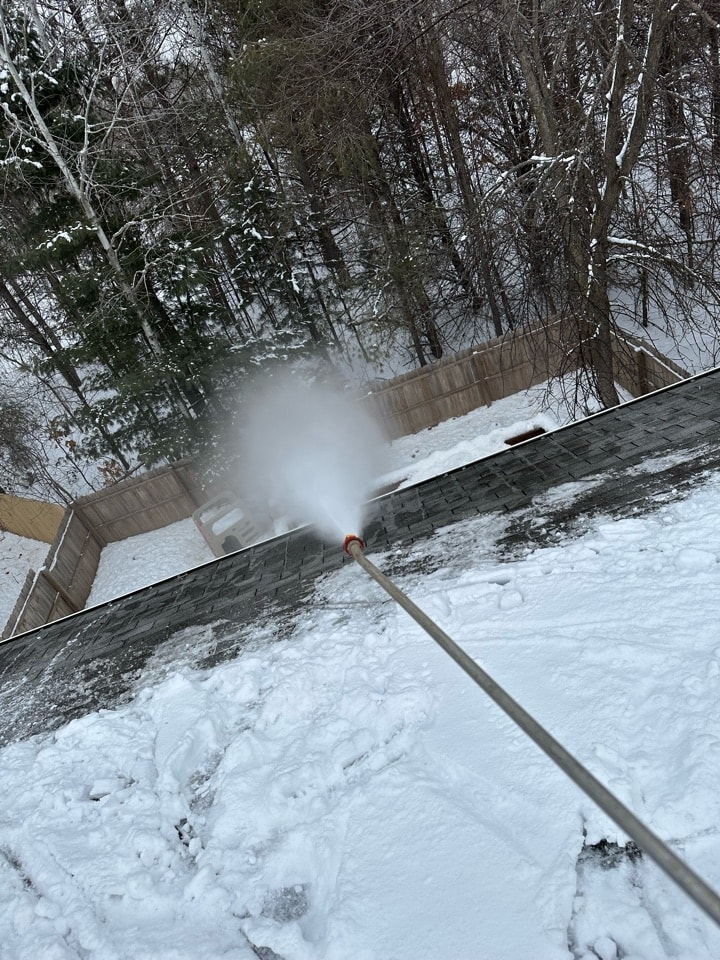
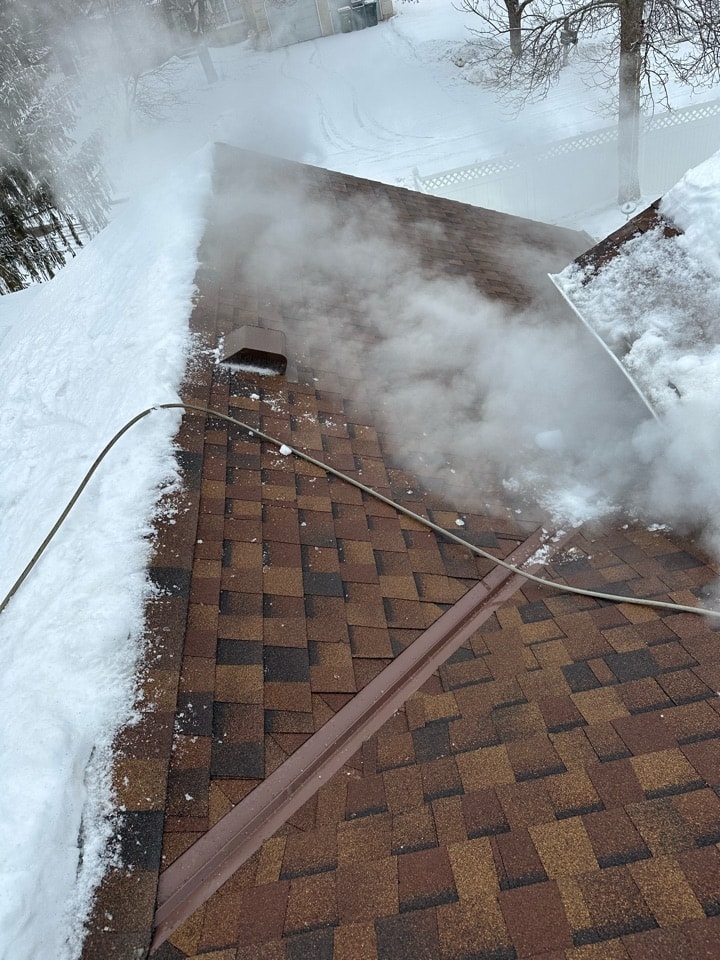
We use steam. Steam melts the ice into small pieces we can clear by hand, without prying at the shingles. We don’t chip ice with hammers or axes, and we don’t blast it with a pressure washer. Both of those can tear shingles and damage the roof edge.
In March 2023, WCCO News featured our crew clearing ice dams with steam. The story covered what we still do today: steam cuts the ice off without damaging the shingles, and the crew comes back afterward to check for moisture behind the wall and for mold.
Start where the water is getting in
When water is already coming in, we start at the leak. We open a channel through the dam so trapped water can drain, then clear the rest of the eave.
Clear the whole eave, not just one spot
Leaving part of the dam in place gives water somewhere to pool the next time snow melts. Ask any company, us included, whether they’re clearing the whole eave or just the leak spot.
The part most ice dam companies skip: inside your house
By the time you see a stain, water has often been soaking the attic insulation, the top of the wall or the ceiling drywall for a while. Clearing the roof doesn’t dry any of that.
Measure, dry and remove what can’t be saved
We check the attic, ceilings and outside walls with moisture meters. We dry what can be dried, and wet insulation that can’t be saved comes out. If mold has started, we handle mold remediation in house with the same crew.
When the ceiling itself needs repair, our ceiling and drywall water damage repair page explains when drywall can be dried, when it has to be cut out and how the patch is matched.
Don’t repair until it’s dry, and fix the heat loss
We follow two pieces of advice from the University of Minnesota Extension on every ice dam job. Don’t repair ceilings and walls until they’re dry. And fix the heat loss at the same time, or the damage will come back.
We’ll point out what we see in the attic, like gaps around lights, vents or the attic hatch. For a full check, Extension recommends a weatherization contractor who can run a blower door test.
What not to do on your own roof
Don’t climb onto an icy roof. Leave it to a crew with the right safety gear.
Don’t chip at the ice with a hammer, ice pick or shovel. Don’t use a pressure washer or a torch.
A roof rake used from the ground can pull snow off before a dam builds. Extension notes that roof rakes can also damage roofing, so keep the blade off the shingles. We tested three styles in our roof rake comparison.
Why homeowners call Kiser for ice dams
Here’s what’s different about calling us.
One company for the roof and the inside
Ice dam removal, drying, mold remediation, insulation replacement, drywall and paint all come from one licensed contractor. You don’t have to find a second company once the roof is clear.
A real person answers, day or night
Our emergency line at (612) 518-8852 is answered by real people, day, night, weekends and holidays.
Certified and licensed since 2003
We’re an IICRC certified firm and a licensed Minnesota residential contractor (BC416441). We’ve been in Elk River since 2003.
Ice dam removal cost: what to ask before the steamer starts
Pricing depends on the size of the roof, how thick the ice is and how hard the roof is to reach. After heavy snow years, demand spikes and some homeowners get quoted steep hourly rates.
Before anyone starts, ask three questions. Is it billed by the hour or by the job? Is there a minimum? Will they clear only the leak area or the whole eave?
Interior repair is priced separately, based on what got wet. A small ceiling stain is a much smaller job than a soaked attic and a wall that needs to be opened.
Our damage inspections are free. If water got inside, we write the interior repair as its own scope, so you can see both parts clearly. We work on 50/50 payment terms, and our repair work carries a one-year warranty from the completion date.
Ice dams and your insurance claim
We photograph the ice, the roof edge, the attic and every wet room before anything is removed. Your adjuster gets the photos, the moisture readings and a written scope. We don’t interpret your policy and we don’t adjust your claim. Learn more about our insurance claim assistance.
Where we remove ice dams
We’re based on Meadowvale Road in Elk River. We remove ice dams and repair the water damage they cause across Sherburne, Anoka, Hennepin and Wright counties.
That includes Elk River, Otsego, Anoka, Coon Rapids, Blaine, Champlin, Brooklyn Park and Maple Grove in the north metro. It also includes Plymouth, Minnetonka and Eden Prairie to the west, and Monticello, St. Michael and Buffalo to the northwest. Homeowners in Blaine can also see our page on water damage restoration in Blaine.
Older homes with complex rooflines and newer homes with recessed lights in the top-floor ceiling both get ice dams. Wherever you are in our area, the process is the same: clear the roof, find every wet spot inside and dry it before anything gets patched or painted.
Ice dams can form any time snow sits on the roof, and they can keep forming into spring as long as the freeze-thaw cycle continues.
Common questions
Yes. Our emergency line at (612) 518-8852 is answered by a person 24 hours a day, 7 days a week, including holidays. If water is already coming in, tell the person who answers so the leak gets handled first.
Steam melts the ice instead of prying it loose, which is why it’s the method professionals use. Chipping with hammers and pressure washing are what crack and tear shingles.
Get it checked before you paint or patch. Water can stay in attic insulation and inside the ceiling after the roof is clear. We measure moisture, dry what can be dried and replace what can’t.
Usually because heat is leaking from the house into the attic. The University of Minnesota Extension lists air leaks around lights, ducts and other openings as a major cause. Removing the ice fixes this year. Stopping the heat loss fixes next year.
Yes. We’re a licensed Minnesota contractor (BC416441). We dry, remove, rebuild and paint, so you don’t need a second company for the inside.
Yes, if water sits in the attic insulation or inside a wall long enough. That’s why we check for moisture behind walls after the ice is gone, and why mold remediation is part of the same job, not a separate company.
Call us
An ice dam is two problems: ice on the roof and water in the house. Kiser Construction handles both, from steam removal to drying, mold remediation and the final coat of paint. If water is coming through a ceiling or wall right now, call (612) 518-8852. A real person answers 24/7, including holidays. For everything else, call our Elk River office at (763) 633-2010. Damage inspections are free, and you’ll get a written scope for the roof work and the interior repair before anything starts.