
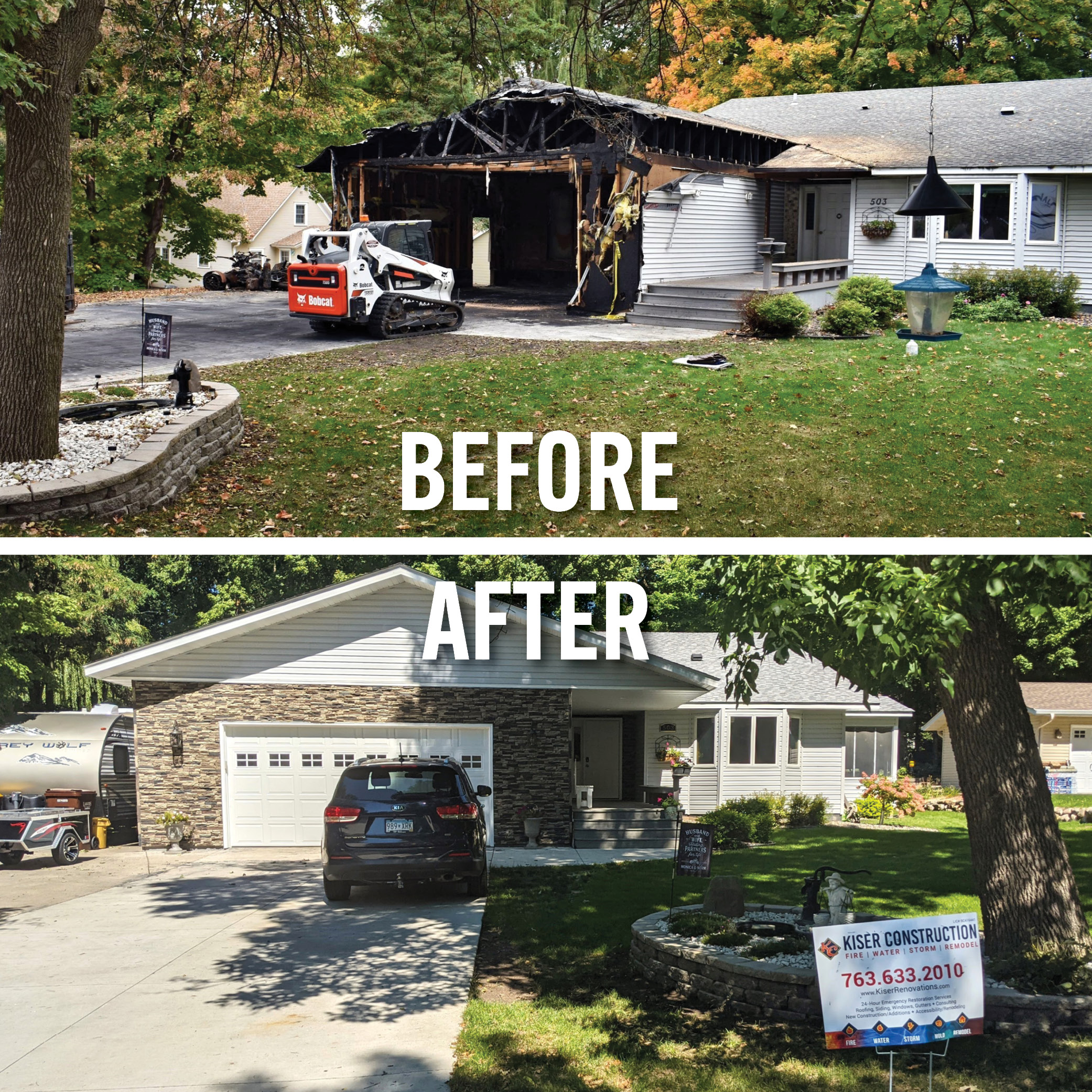
Garage Fire Damage Restoration
The attached garage is where a Minnesota house keeps most of what can burn. It is also a room where the code does not require a smoke alarm.
Gas cans. A snowblower with fuel in it all summer. A mower with fuel in it all winter. Paint, solvents, propane, a chest freezer, and a car. Most of it sits against a wall that shares framing with the living room.
Garage fire damage restoration is unlike other fire work for one reason. Your rebuild scope is usually not set by the burn pattern. It is set by the wall between the garage and the house.
Is this the right page?
This page covers garage fires and what they mean for the rebuild. For fire in the living space, our fire damage restoration page covers the full sequence. We handle fire, water and storm restoration throughout the northwest metro.
The separation wall decides your scope
This is the part that surprises people, and it is where a lot of garage rebuilds go wrong.
Minnesota code requires the garage to be separated from the house. Minnesota Rules 1309.0302 sets the assembly.
The wall between the two needs at least half-inch gypsum board on the garage side. If there is a habitable room above the garage, that ceiling needs five-eighths inch Type X.
The separation carries up into the attic too. The wall between the garage attic and the house attic has to run all the way up to the roof sheathing.
The Minnesota Residential Code also covers what passes through that wall. Ducts running through a garage have to be sheet metal of a set minimum gauge, with no registers opening into the garage. Penetrations around pipes, wires, and vents have to be sealed.
Here is why that matters after a fire. If the assembly was damaged, or was never right to begin with, it gets rebuilt to current code. That is not the contractor being fussy. It is what the inspector looks for. It is also the usual gap between the scope you expect and the scope that gets approved.
It is also worth knowing what that wall was meant to do, before you decide how to fill the rebuilt garage.
One thing national advice gets wrong here
You will read almost everywhere that the door between the garage and the house needs a self-closing device. That is the international code.
Minnesota took that requirement out. It used to be in our code. It is not any more.
The door still has to be the right type: solid wood or solid or honeycomb-core steel at least 1-3/8 inches thick, or a 20-minute fire-rated door. There is still no door allowed between a garage and a bedroom. But the self-closer is not a Minnesota rule.
We raise it because a contractor working from national guidance will sometimes quote things this state does not require, and sometimes miss things it does.
Why garage fires reach the house
Two paths, and both go upward.
The first is the attic. If the separation up there is incomplete, fire and smoke move straight from the garage attic into the house attic. In older homes and in garages somebody finished themselves, it is often incomplete.
The second is the wall itself. Fire in a wall cavity goes up. If fireblocking is missing at the top, it keeps going.
So a garage fire that never touched the living space can still leave smoke damage through the whole upper floor, and an attic full of contaminated insulation. That is smoke damage cleanup on top of the garage rebuild. We inspect both attics on every attached garage fire, visible damage or not.
The chemical load
Garage fires burn differently from house fires because of what is stored in them.
Fuel, solvents, pesticides, and automotive fluids leave heavier residue than a furniture fire. Vehicles add plastics, rubber, foam, and fluids of their own. The result is oilier, it carries further, and it is harder to get out of porous surfaces.
So we inventory what was in there before cleanup starts. It changes the handling and it changes what can be saved. Tell us if anything unusual was stored, even if you would rather not.
Detached garages are a different job
If the garage is detached, the separation question mostly goes away and two others take its place.
The first is proximity. Minnesota code treats an accessory building near the house differently. A garage less than 3 feet from the house needs half-inch gypsum board on the inside of the walls in that area. If yours sits that close, that changes the rebuild.
The second is what the fire did to everything around it. Detached garage fires often scorch siding, melt soffit and gutters, and crack windows on the house without ever spreading to it. That damage needs to be documented along with the garage. It gets missed when everyone is focused on the garage itself.
What garage fire damage restoration involves
- Secure the structure and confirm the garage is safe to enter
- Inspect both attic spaces and the full separation assembly
- Document the loss, including a contents inventory of what was stored
- Remove damaged framing, sheathing, insulation, and gypsum
- Handle soot removal on the house side, which is usually needed even when the fire never got there
- Rebuild the separation assembly to current Minnesota code
- Rebuild the garage, including door, opener, and finishes
Storing things differently afterward
A rebuild is the moment to change what caused the problem.
- Keep gasoline in approved containers and in small amounts, away from any ignition source including the water heater
- Drain fuel from seasonal equipment before it sits for six months
- Keep the area around a furnace or water heater in the garage clear
- Do not store propane cylinders in an attached garage
- Add a heat detector rather than a smoke detector. Garages are too dusty and swing too far in temperature for smoke units.
Common questions
The fire stayed in the garage. Why are you inspecting the house?
Because smoke does not respect the separation the way fire does. Shared attic space and wall penetrations carry it. We check rather than assume.
Does my garage door and opener get replaced?
Often. Heat warps panels and cooks opener electronics even when the door still runs. We document both for the claim.
What about my vehicle?
Call your auto insurance agent about it early. We document where the vehicle was and what state it was in.
Can the concrete floor be saved?
Usually. Concrete picks up staining and odor from fuel and fluids. It gets cleaned and sealed rather than replaced.
Will the attic insulation need replacing?
If smoke reached it, yes. Blown insulation holds odor and cannot be cleaned in place, so it is removed and replaced rather than treated.
How long does a garage rebuild take?
Less time than a comparable house fire, because the finishes are simpler. Insurance approval is still usually the longest part of the timeline.
Can I clear the garage out myself before you arrive?
Please do not, until we have documented it. What was stored in there affects both the handling and the claim, and once it is at the curb it cannot be inventoried.
Call us
If the structure is still open, emergency board up and tarping comes first. If a battery started the fire, we have written separately about the dangers of lithium-ion batteries.
Kiser Construction handles garage fire damage restoration across Sherburne, Wright, Anoka, and Hennepin counties. We do cleanup and reconstruction with one team. We have been in business since 2003 and are licensed in Minnesota under BC416441. Inspections are free and you get a written scope whether or not you hire us.
Emergency line, any hour: (612) 518-8852. Office: (763) 633-2010.