Smoke Damage Cleanup in Coon Rapids
A lot of the smoke damage cleanup in Coon Rapids we get called to has no fire attached to it at all.
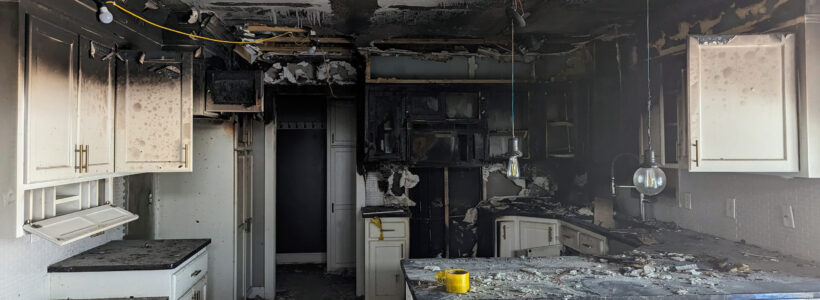
The homeowner comes home to a grey film on every horizontal surface. Or there is a smell in the house that was not there yesterday. Or a wall that was white in October has faint dark stripes running up it in February, evenly spaced, and nobody can explain them. There was no fire. Nothing burned. The house is still full of soot.
This is the version of smoke damage that gets handled badly, because it does not look like an emergency and it does not come with a fire report.
Furnace puffback
The most common cause we see in this city is a puffback.
A forced air furnace is supposed to ignite the moment fuel is introduced. When ignition is delayed, unburned fuel builds up in the combustion chamber for a second or two and then lights all at once. The pressure pulse pushes soot out of the appliance and, if the system shares the ductwork, distributes it through every supply register in the house.
You get a fine black oily residue in rooms nowhere near the furnace. It settles on top of doorframes, on the blades of ceiling fans, on lampshades, inside closets. It is greasy rather than dusty, which is why wiping it usually smears it.
Coon Rapids has a large stock of homes from the 1950s through the 1970s, and plenty of them are on their second or third furnace with original ductwork. Late winter is when the calls come, after a heating system has run hard for three months.
Ghosting, and why your walls have stripes
If you have ever seen dark vertical lines on a wall that match the stud spacing, or a dark outline around every ceiling joist, that is ghosting.
It happens because studs and joists conduct cold differently than the insulated cavity between them. Those cooler strips of wall collect soot particles out of the air more readily than the warmer areas beside them. Over a Minnesota winter, in a house with a soot source, the pattern prints itself onto the paint.
The soot source is usually mundane. Candles, especially scented ones with soft wax. A fireplace that is not drawing properly. Cooking oil. A furnace that is not burning cleanly.
Ghosting is worth taking seriously, not because the stripes are dangerous but because they are evidence. Something in the house is putting combustion particles into the air continuously, and the walls are just the part you can see.
Why cleaning it yourself usually makes it worse
Soot is not dust. The particles are extremely fine, they are oily, and they are acidic.
Wipe them with a damp cloth and you drive them into the paint and into porous surfaces where they set. Vacuum them with a household vacuum and the filter passes them straight back into the room. Both are common, and both turn a cleanable surface into one that has to be sealed or replaced.
The acidity matters too. Soot keeps working on what it is sitting on. Bare metal, chrome fixtures, appliance finishes and grout all degrade the longer it stays, which is why time matters even when there is no visible emergency.
Proper soot removal starts dry, with chemical sponges and HEPA vacuums, and only moves to wet cleaning where the surface calls for it and in the right order.
Getting the smell out
Odor is a separate problem from residue, and getting the surfaces clean does not always finish it.
Smoke odor lives wherever the particles went, which includes wall cavities, insulation, carpet pad and ductwork. In a puffback, the ductwork is almost always part of the job, because that is the distribution system that spread it.
We work through smoke odor removal as its own process, and we would rather tell you a room needs its insulation replaced than sell you a deodorizing fog that buys three weeks.
How smoke damage cleanup in Coon Rapids is done
Find the source first. There is no point cleaning a house that is still producing soot, so if the furnace is the cause it gets serviced before we start.
Then we map the spread. Smoke damage cleanup in Coon Rapids is mostly a question of extent rather than severity, and the extent is almost always larger than the visible residue.
Then dry cleaning, then wet cleaning where appropriate, then contents, then ductwork, then sealing and repainting anything that will not come clean. Your belongings get handled separately, with different methods for upholstery, clothing, documents and electronics.
Is it covered?
Sudden and accidental events tend to be treated differently than gradual ones, and a puffback usually looks more like the former than the latter. We are not your insurer or an adjuster and we will not tell you how your policy reads.
What we will do is document the loss properly. Photographs, a written scope, residue mapping, and a clear account of what happened and when, given to your adjuster in the format they work in. A puffback claim frequently comes down to whether anyone documented the extent before the cleaning started, so call before you clean.
One company, cleanup through repaint
We clean it and, where the surfaces cannot be saved, we repair and refinish them. Same project manager throughout.
Kiser Construction has been working out of Elk River since 2003. IICRC certified, licensed and bonded, Minnesota license BC416441, one year warranty from completion. We handle damage restoration across Ramsey, Anoka and Coon Rapids, and if there was an actual fire involved, we also do fire damage restoration in Coon Rapids.
Call us
Emergency line 612-518-8852, answered by a person at any hour. Office 763-633-2010, 9 to 5. Inspections are free.
Frequently Asked Questions
There was no fire. Why is there black residue everywhere?
The most likely cause is a furnace puffback, where delayed ignition pushes soot out of the appliance and the duct system distributes it through the house. Candles, a poorly drawing fireplace and cooking can also produce enough soot to coat a home over a season.
What are the dark stripes on my walls and ceiling?
That is ghosting. Studs and joists stay cooler than the insulated cavities between them, so soot in the air collects on those strips first and prints the framing pattern onto the paint. It means something in the house is producing soot continuously.
Can I clean soot myself?
We would advise against it. Soot is oily and very fine, so wiping tends to drive it into the surface and a household vacuum tends to blow it back into the room. Both turn a cleanable wall into one that needs sealing or replacing.
Does soot damage anything besides paint?
Yes. It is acidic and it keeps acting on whatever it is sitting on. Chrome, bare metal, appliance finishes and grout all suffer the longer it stays, which is why a puffback is worth treating quickly even though nothing burned.
Do you have to clean the ducts?
On a puffback, nearly always. The ductwork is how the soot reached rooms far from the furnace, and leaving it means the system redistributes residue the next time the heat runs.
Should I clean up before the adjuster sees it?
Photograph everything first, and call us before cleaning. The extent of a smoke loss is the hardest part to prove after somebody has wiped it down, and documentation is what the claim gets built on.
How long does smoke damage cleanup take?
A single room may be a day or two. A whole house puffback with duct cleaning and repainting runs longer. We will give you a scope and a realistic schedule after the inspection.
What Can We Help You with Today?
Click below to see how we can help you with fire damage, water damage, or storm damage.