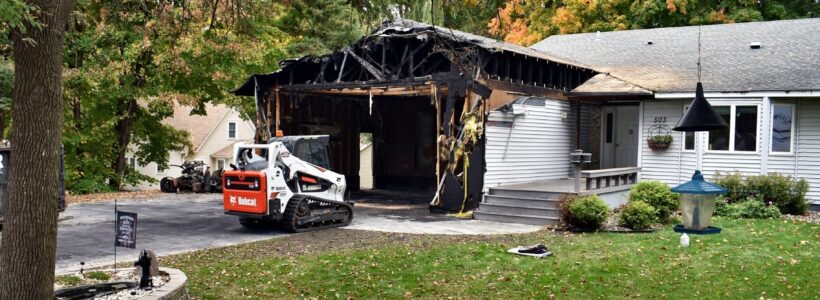
Fire Damage Restoration in Coon Rapids
Fire damage restoration in Coon Rapids often turns up something that did not start the fire but made it worse. Coon Rapids was built in a hurry, and the timing of that hurry left something behind in the walls.
Between 1965 and 1973, copper prices climbed and some builders substituted single strand aluminum for copper in branch circuit wiring. That is the wire feeding your outlets, switches and light fixtures. The Consumer Product Safety Commission later found that homes wired with pre 1972 aluminum are 55 times more likely to have one or more connections reach what it calls fire hazard conditions than homes wired with copper.
Coon Rapids built out straight through that window. Any fire damage restoration in Coon Rapids that happens in a house from that era deserves a look at the wiring, whether or not it is what started the fire.
Why the wire is not the problem
This is the part that gets misreported constantly. Aluminum conducts electricity perfectly well. Large aluminum feeder cable is still used today and it is fine.
The failure is at the connections. Aluminum expands and contracts more than copper as a circuit heats and cools, and it oxidizes differently. Over decades the screw terminal at an outlet works loose. A loose connection arcs. Arcing inside a wall box, behind a plate, with insulation nearby, is how a house catches fire at two in the morning with nothing plugged in.
It gets worse where circuits are heavily and constantly loaded, which in a Coon Rapids rambler usually means the kitchen and the laundry.
What to look for, and what not to do
Do not pull outlets apart to check. If you want to look at anything, look at the cable jackets where they enter the panel or where they are visible in an unfinished basement or attic. Aluminum cable is usually marked AL or ALUMINUM along the sheathing.
Warning signs inside the house are worth taking seriously: outlets or switch plates that feel warm, a faint smell of hot plastic near a receptacle, lights that flicker on one circuit, or a breaker that trips without an obvious cause.
The CPSC does not tell people to live with it. It describes repair options ranging from a full copper rewire to approved crimp connectors at every connection. Any of them is an electrician’s job, not a weekend project.
The other thing about houses from this era
Coon Rapids has a lot of split levels and split entries, and they behave differently in a fire than a two story or a rambler does.
A split entry puts the front door on a landing between floors, with an open stairway running up and another running down. There is no door at either end. That stairwell is a chimney, and it is the shortest possible path from a lower level utility room to the bedrooms above.
It also means smoke reaches the upper floor before flame does, and often before anyone downstairs realizes what is happening. Smoke alarms on both levels are not a nice to have in this layout.
The first night after a fire
When the fire department leaves, your house is open. Windows are broken, there may be ventilation holes cut in the roof, and the doors may not lock.
Call 612-518-8852 and we will board up and tarp, usually the same night. Beyond keeping weather and people out, most policies expect an owner to take reasonable steps to prevent further loss after a fire, so securing the building is part of protecting the claim.
Then the assessment, documented with photographs and a written scope before anything moves. Damage nobody found is damage nobody pays for.
The water nobody warns you about
A single attack line puts a great deal of water into a house very quickly, and in a split level that water goes straight down to the lowest floor. On plenty of jobs the water damage is larger by volume than the fire damage.
We are IICRC certified on both, so extraction and drying start the same day as the board up rather than waiting on somebody else’s subcontractor to have an opening. Fire damage restoration in Coon Rapids is a water job about as often as it is a fire job.
Smoke goes where the fire did not
Smoke follows air. It moves through wall cavities, up into the attic, through the return ducts, and settles in rooms that never saw flame. The particles embed in porous materials and stay there.
Wiping the walls down buys about three weeks. Then the first humid stretch arrives and the smell comes back, because the source was never removed. Doing it properly means finding where the smoke actually went. We treat smoke damage cleanup in Coon Rapids as its own discipline rather than a finishing step.
Where these fires start
Two rooms account for most of what we see. We handle kitchen fire damage restoration and garage fire damage restoration as separate services because the rebuild work is genuinely different in each.
Kitchens bring grease residue, cabinet matching problems, and appliances that may or may not be safe to keep. Garages bring solvents, fuel, and a separation wall between the garage and the house that decides how much of the house was ever at risk.
Fire damage restoration in Coon Rapids, board up to final coat
We are a licensed general contractor, not only a mitigation crew. Board up, demolition, drying, odor removal, then framing, drywall, trim, paint and flooring. Same project manager the whole way, so there is nobody to point at when something slips.
Kiser Construction has been in business since 2003, working out of Elk River. IICRC certified. Minnesota license BC416441. One year warranty from the date we finish. We provide damage restoration across Ramsey, Anoka and Coon Rapids.
Call us
Emergency line 612-518-8852, any hour, answered by a person. Office 763-633-2010, 9 to 5. Assessments are free.
Frequently Asked Questions
How do I know if my Coon Rapids home has aluminum wiring?
Age is the first clue. Homes built or rewired between 1965 and 1973 are the ones to check. Visible cable in an unfinished basement or attic is often marked AL or ALUMINUM on the jacket. Do not open outlets to look. An electrician experienced with aluminum can confirm it quickly.
Is aluminum wiring dangerous on its own?
The wire itself carries current fine. The risk is at the connection points, where aluminum loosens and oxidizes over decades until it arcs. That is why the hazard grows with age rather than showing up when the house is new.
Can I just replace the outlets?
Not with ordinary devices, and this is a job for an electrician who has specifically worked with aluminum. The CPSC describes accepted repair methods, and some pigtailing approaches can make the problem worse rather than better if done wrong.
Will the water used to fight the fire cause its own damage?
Almost always, and in a split level it usually ends up on the lowest floor. It is frequently the larger of the two losses by volume. We handle both, so the drying starts the same day rather than waiting on a subcontractor.
Can smoke odor be removed permanently?
Yes, if the source is removed rather than masked. Smoke settles inside wall cavities, insulation and ductwork. Surface cleaning gets you a few weeks of relief and then it returns.
Who secures my house after the fire department leaves?
We do, usually the same night. Call 612-518-8852. Until openings are covered the house is exposed to weather and to anyone walking past.
How long does a fire restoration take?
It depends on how much of the structure is involved and how quickly the claim settles. A contained kitchen fire is a very different job from one that reached the roof. We will give you a realistic schedule after the assessment rather than an optimistic one before it.
What Can We Help You with Today?
Click below to see how we can help you with fire damage, water damage, or storm damage.