Fire Damage Restoration in Brooklyn Park, MN
Nobody warns you about the water. You watch the fire get put out, you feel relief, and then a few hours later somebody points a flashlight into your basement and there is four inches standing on the floor. Fire damage restoration in Brooklyn Park is almost always two losses stacked on top of each other, and the second one causes more of the destruction than most homeowners expect.
A single attack line moves a lot of water very quickly. In a Brooklyn Park rambler with a finished lower level, that water goes exactly where gravity sends it, straight down through the floor and into the room below. Whatever the fire did not reach, the water often did.
Why this matters for who you hire
Plenty of companies doing fire damage restoration in Brooklyn Park subcontract the drying. That means one crew for soot, a different crew for water, two schedules, and a seam in the middle where things get missed. We are IICRC certified on both, so the extraction and drying start the same day as the board-up rather than waiting on somebody else’s calendar.
It also means one assessment. Fire damage and water damage overlap in ways that are easy to misread if you are only looking for one of them. Charred framing that is also saturated behaves differently than either problem alone.
Where fires start in Brooklyn Park homes
The 85th Avenue development line shapes this too. South of 85th, the housing is from the 1950s and 60s, and the risks skew toward aging systems. Electrical panels and branch wiring that were sized for a very different set of appliances. Kitchens that have been remodeled around original circuits. Furnaces and water heaters sharing decades-old venting.
North of 85th, almost everything went up after 2000. The wiring is fine. The pattern shifts toward attached garages, gas fireplaces, and large open floor plans that let a fire and its smoke move through the house with very little to slow them down.
Neither pattern is unusual, and neither is anyone’s fault. The National Fire Protection Association publishes plain guidance on how home fires start that is worth ten minutes of anyone’s time, whether or not you have ever had one.
Fire damage restoration in Brooklyn Park: the first twenty-four hours
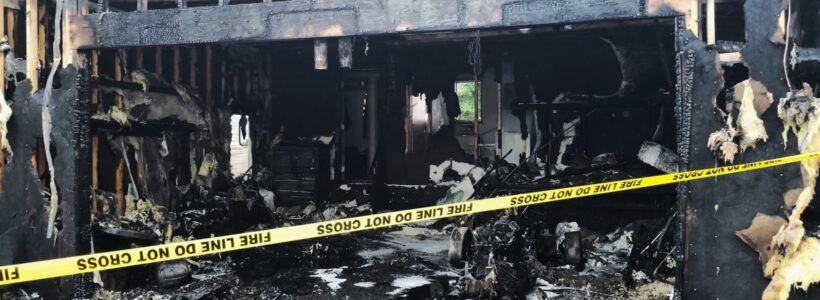
When the fire department leaves, your house is open. Windows are broken, there may be holes cut in the roof for ventilation, and the front door may not lock. Weather gets in. So does anyone walking past.
Board-up and tarping is the first call, and we can do it the same night. Most policies also expect you to take reasonable steps to prevent further damage after a loss, so securing the property is not just practical, it protects the claim.
After that comes the assessment. We document everything with photographs and written scope before anything is moved, because that record is what the claim gets built on.
Smoke and odor, and why surface cleaning fails
Smoke does not stay where the fire was. It follows air currents into wall cavities, up into the attic, through the return ducts and into rooms that never saw flame. The particles are small enough to embed in porous materials and sit there.
That is why wiping down walls makes the smell go away for about three weeks. The surfaces are clean. The source is not. Doing it properly means finding where the smoke actually went, cleaning or removing the affected materials, treating the ductwork, and sealing what needs sealing.
Your belongings get handled separately. Contents cleaning is its own process with its own methods depending on whether we are working on upholstery, documents, electronics or dishes.
Why your first insurance check is smaller than the estimate
This surprises almost everyone, and it is worth understanding before it happens to you.
Most policies pay in two stages. The first check is actual cash value: replacement cost minus depreciation. If your roof was fifteen years into a twenty-five year life, the insurer subtracts for the fifteen years you already used. The estimate says one number and the check says a smaller one, and it looks like a mistake.
On a replacement cost policy, that withheld amount is usually recoverable depreciation. The insurer releases it after the work is actually done and documented. It was never denied, it was held. Some depreciation is non-recoverable and that portion does not come back, which is why reading the difference on your own paperwork matters.
We document completed work in the format adjusters need so the recoverable portion gets released without a fight. It is unglamorous and it is worth real money to you.
One company from board-up to rebuild
We are a licensed general contractor, not only a mitigation company. The crew that boards up your house is part of the same company that frames it back, hangs the drywall, and hands you the keys. Same project manager the whole way.
Kiser has been doing this since 2003, out of Elk River, about twenty minutes up Highway 169 from Brooklyn Park. IICRC certified. Minnesota license #BC416441. One-year warranty on the work from the day we finish.
Call us
The 24-hour emergency line is 612-518-8852 and a person answers it. Office is 763-633-2010, 9 to 5. Damage assessments are free. If you need fire damage restoration in Brooklyn Park, start with that call and we will take it from there. We also respond to fire damage in Maple Grove homes just across the city line.
Frequently Asked Questions
Can I go back into my house after a fire in Brooklyn Park?
Not until the fire department clears it, and even then be careful. Floors and stairs can be structurally compromised in ways that are not visible, and the air can carry soot and combustion products worth avoiding. Wait for the all clear, then let a restoration crew assess the structure before you start moving things.
Who boards up my home, and how fast?
We do, and we can be out the same night. Call 612-518-8852. Once the fire department leaves, your house is open to weather and to anyone who walks past, and most policies expect you to take reasonable steps to prevent further loss. Board-up and tarping is that step.
Will the water used to put out the fire cause its own damage?
Almost always, and it is usually the larger of the two problems by volume. A fire on the main floor can put hundreds of gallons into the basement below. We are IICRC certified on both fire and water, so the drying starts the same day rather than waiting on a subcontractor.
Why is my insurance check smaller than the estimate?
Because the first payment is usually actual cash value, which is the replacement cost minus depreciation for age and wear. The depreciated portion is often recoverable, meaning the insurer releases it once the work is actually completed and documented. It is not money you have lost, it is money held back until the job is done.
Can smoke odor be removed permanently, or will it come back?
It can be removed permanently, but only if the source is removed. Smoke particles settle inside wall cavities, ductwork, insulation and porous materials. Cleaning the surfaces makes the smell go away for a few weeks and then it returns on the first humid day. Doing it properly means getting into the places the smoke actually went.
Do you handle the rebuild after the cleanup?
Yes, all of it, with one project manager start to finish. Board-up, demolition, drying, odor removal, then framing, drywall, trim, paint and flooring.
How long does a fire restoration take from start to finish?
It depends on how much of the structure is involved and how quickly the claim is settled. A contained kitchen fire is a very different job from a fire that reached the roof. We will give you a realistic schedule after the assessment rather than an optimistic one up front.
What Can We Help You with Today?
Click below to see how we can help you with fire damage, water damage, or storm damage.